
Uncategorized


If you want to get the attention of non-technical stakeholders, these are the three most powerful charts to immediately grab folks' interest and get them to care about site speed and user experience.
I’ve spent almost two decades making the case that performance is not just a technical problem — it’s a business problem.
I’ve spoken about the intersection of performance, user experience, and business at more conferences than I can count. I’ve written numberless posts and articles. I even wrote a book. And the pattern I keep seeing doesn’t change: the data is almost always there.
Teams have data. They have numbers that prove the cost of slowness. What they don’t have is a translation that matters for the rest of the business.
Here’s what I’ve found actually works.

Back when my web performance BFF Cliff Crocker was running performance and reliability at Walmart Labs, his team had a problem many of you might be familar with. Leadership understood the site should be fast, but they didn’t feel the urgency. Performance work kept losing out to other priorities.
What changed things at Walmart Labs wasn’t a new tool or a better metric. It was a chart — one that plotted page speed against conversion rate using data they already had.
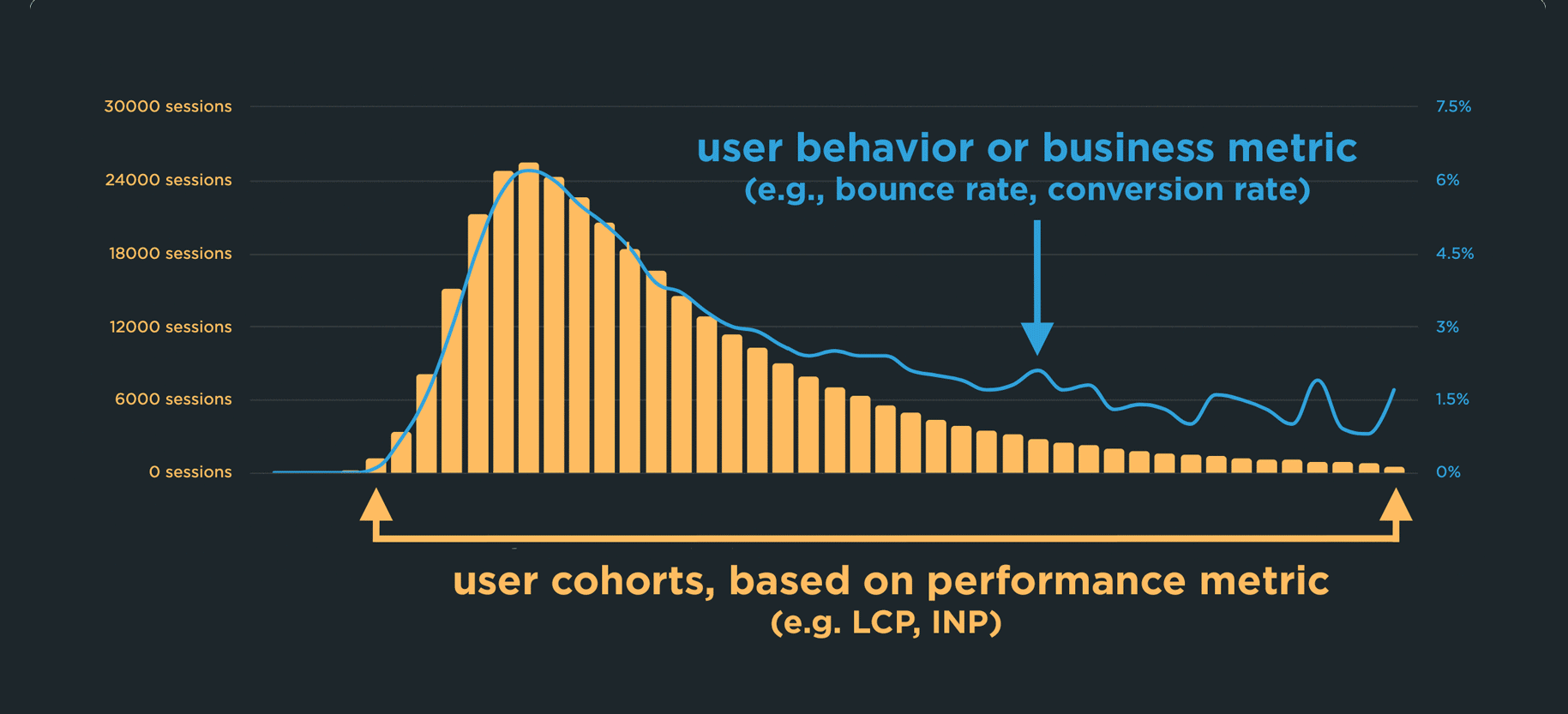
The shape of that chart did something that no amount of technical explanation could: it showed the business cost of slowness in language that leadership already spoke.
When the site was at its fastest, product pages converted best. As it got slower, there was a visible drop in conversions. The slope might have been directional rather than precise, but it was their data and their revenue. Nobody needed to understand what “frontend time” meant to understand that graph.
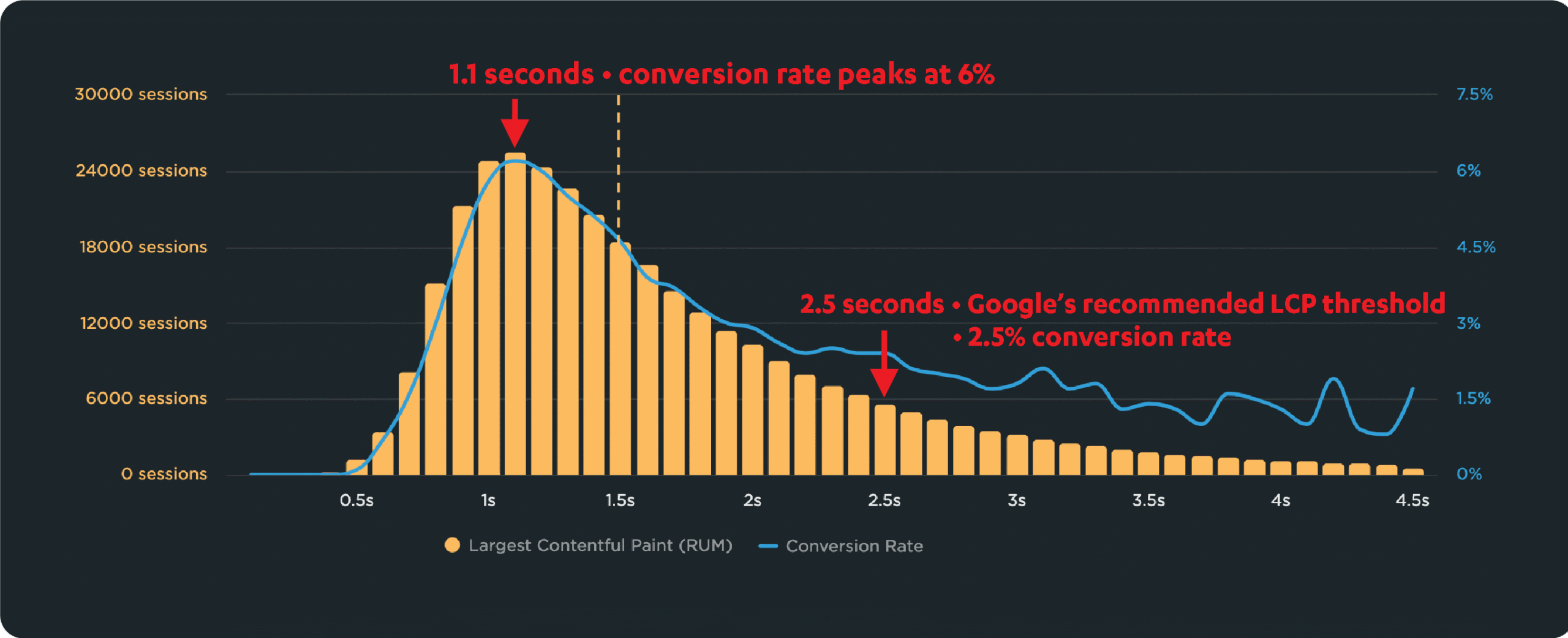
You can build a correlation chart for your own site today. Pull your Largest Contentful Paint (LCP) data from your RUM tool, plot it against conversion rate over the same period, and see what shape you get.
Two things to keep in mind:
First, don’t use someone else’s thresholds. The number that mattered at Walmart Labs is not your number. Every site’s curve looks different. The value isn’t the specific millisecond — it’s making your data visible to the people who make decisions about your site.
Second, be ready for the causation pushback. A sharp stakeholder will say “correlation isn’t causation” — and they’re right, technically. The chart isn’t proof; it’s a conversation starter. It shifts the discussion from “we should make the site faster” to “here’s what we think slowness is costing us.” That’s a business problem worth taking seriously, not a technical preference worth debating.
There’s a faster version of this conversation, and it works on people who genuinely cannot engage with performance metrics at all: show them a competitive benchmark leaderboard where your site is last.
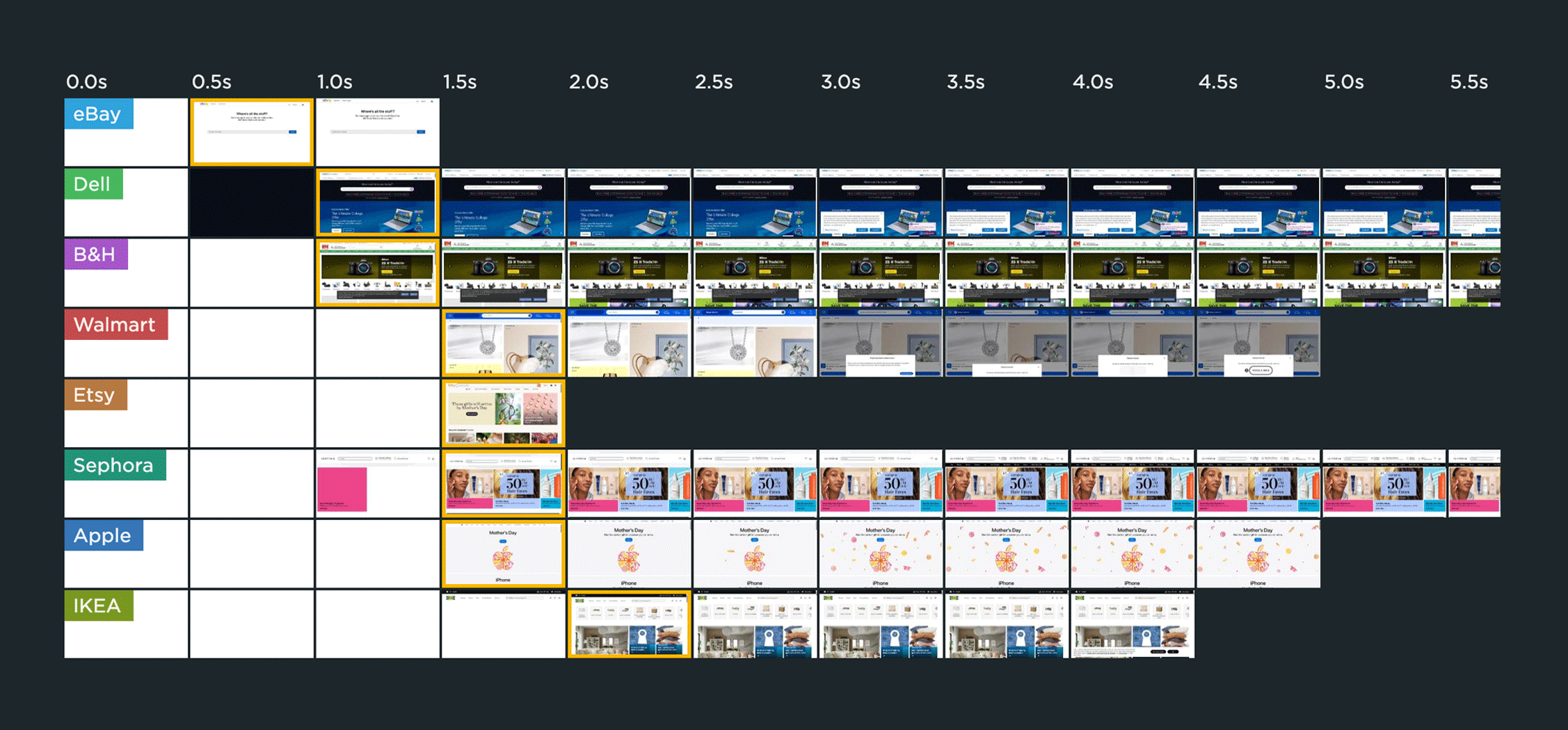
Synthetic monitoring lets you test competitor pages alongside your own pages under identical conditions — same network throttling, same device profile, same browser. Presented as a leaderboard, it does something that internal metrics almost never manage: it makes site speed visible to someone who doesn’t know what LCP means. Nobody needs a background in web performance to feel the competitive implication of finishing fifth out of five.
I’ve heard this story so many times: “We showed our business leaders a leaderboard. We were dead last. Suddenly everyone really cared.” Is the timer still running on your page while your competitor’s page has finished loading? Oof. There’s no metric that illustrates that pain better than a visual.
The flip side is equally useful. Teams who’ve done the work — whose pages are consistently fast — have asked to be put on SpeedCurve’s public-facing Page Speed Benchmarks dashboard specifically so they can screenshot the results and show their bosses. Beating Amazon on page speed is a more effective executive communication tool than any performance report I’ve ever seen.
(Page Speed Benchmarks gives you a daily snapshot of performance across leading retail, travel, media, and tech sites in the US, UK/EU, and Japan. If you’ve never tried competitive benchmarking internally and you want to see what it can look like, this dashboard is a good place to start.)
Conversion rate is powerful, but it only captures a slice of the picture. Not every frustration shows up in conversion data. It shows up in churn, in support volume, in users who quietly ghost your site.
This is the problem the User Happiness score is designed to address. Rather than a single technical metric, it scores sessions as happy, tolerable, or unhappy based on a composite of performance signals. You get a segment: this cohort of users is having unhappy experiences. Here’s what’s different about them.
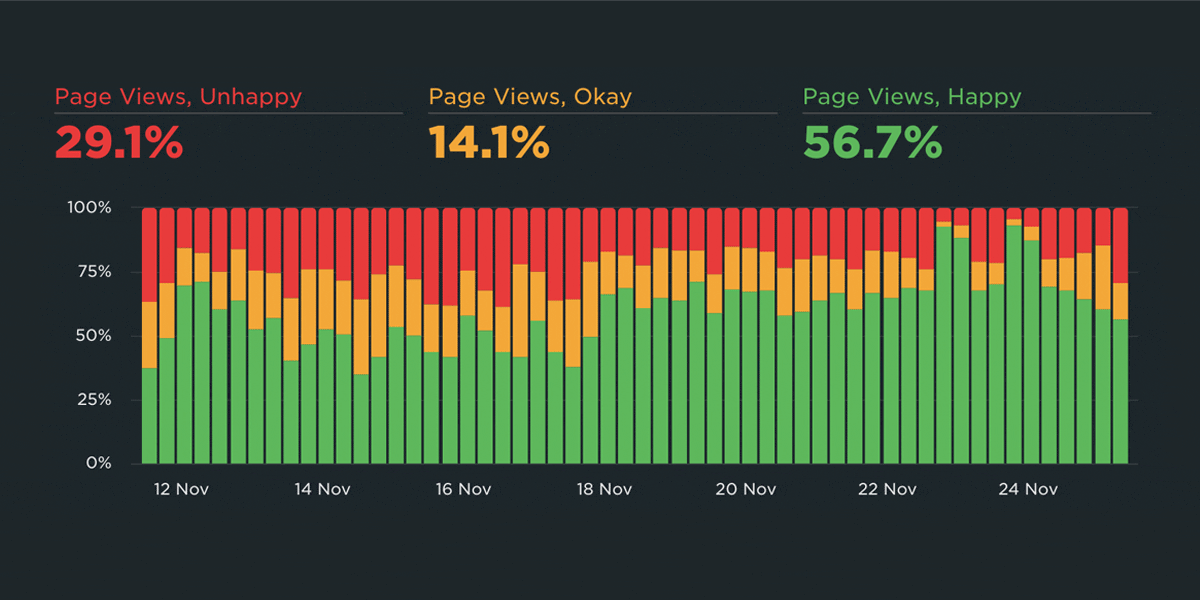
“15% of our users had an unhappy experience this week” lands differently in a business conversation than “our median INP was 340ms.” Both might be describing the same problem, but one definitely gets a much bigger and more emotional response.
We created the User Happiness score at SpeedCurve and are bringing into Embrace — expanding it to cover mobile alongside web, so you can communicate user impact across your website and mobile apps.
None of this requires new instrumentation. The correlation chart, the competitive leaderboard, the User Happiness score — these are different lenses on data that most teams are already collecting.
The gap isn’t the data. It’s who sees it, and how it’s framed when they do. Your RUM tool is generating evidence about the cost of slowness every day. The question is whether the people who hold the budget ever see it in a form that means something to them.
Remember: Data is only one part of storytelling. Emotion is the second part. It’s not enough to tell people your site is slow. You need to make them feel how that hurts – for your users and for your business.
Web Performance Week is our free virtual mini-conference taking place May 4-8. One signup gets you five days of live sessions, posts, and conversations with me, Cliff Crocker, Andy Davies, and Jared Freeze. (If you can’t make it to the live sessions, we’ll send out a wrap-up with all the recordings and insights at the end of the week.)
 Deliver incredible mobile experiences with Embrace.
Get started today with 1 million free user sessions.
Get started free